THE BETTER
Words such as beginner, senior, women or home workout help organize a product catalogue. They can describe the intended audience, presentation or theme, but they do not assess an individual reader. Two people who fit the same audience label may have different experience, equipment, mobility and support needs. This guide explains how to use those labels as a starting point while examining the document itself. It offers a way to frame questions, not a method for clearing yourself to follow a particular exercise.
Read an audience label as a catalogue signal
An audience label tells you where the seller has positioned the resource. It might indicate a slower-looking layout, familiar equipment, particular illustrations or an intended style of reference. The label alone cannot establish how detailed the instructions are or whether every pictured movement is appropriate for every reader in that group. Start by asking what visible feature supports the label. Is there a stated experience level, an explanation guide or a clear equipment list?
A hypothetical beginner poster could be a compact reminder intended for people who already know its movements. Another beginner workbook could explain terminology across several pages. Both use the same audience word, but their instructional roles differ. Do not assume the second exists because the first has a friendly title. Treat catalogue labels as navigation aids. They help you find a sample to inspect, after which the actual content should determine whether the document serves the task you have in mind.
Separate your reading needs from movement needs
Document preferences include font size, language, paper dimensions, page density and whether you want a wall reference or a booklet. Movement needs include personal technique, limitations and the guidance appropriate to your circumstances. A seller can often clarify the first group by showing samples and describing files. The second group may require an instructor or clinician who can consider you individually. Mixing the groups makes a technical product answer sound more personally meaningful than it is.
For example, a large-print chart could be easy to read while showing movements you should not assume are suitable for you. A densely printed guide could contain useful information but be impractical at your preferred reading distance. Evaluate these issues separately. You can reject a file because it is unreadable without making a judgment about its entire exercise content. Equally, attractive typography does not remove the need for individual advice where that advice is relevant to the activity you intend to follow.

Inspect the assumptions shown on the page
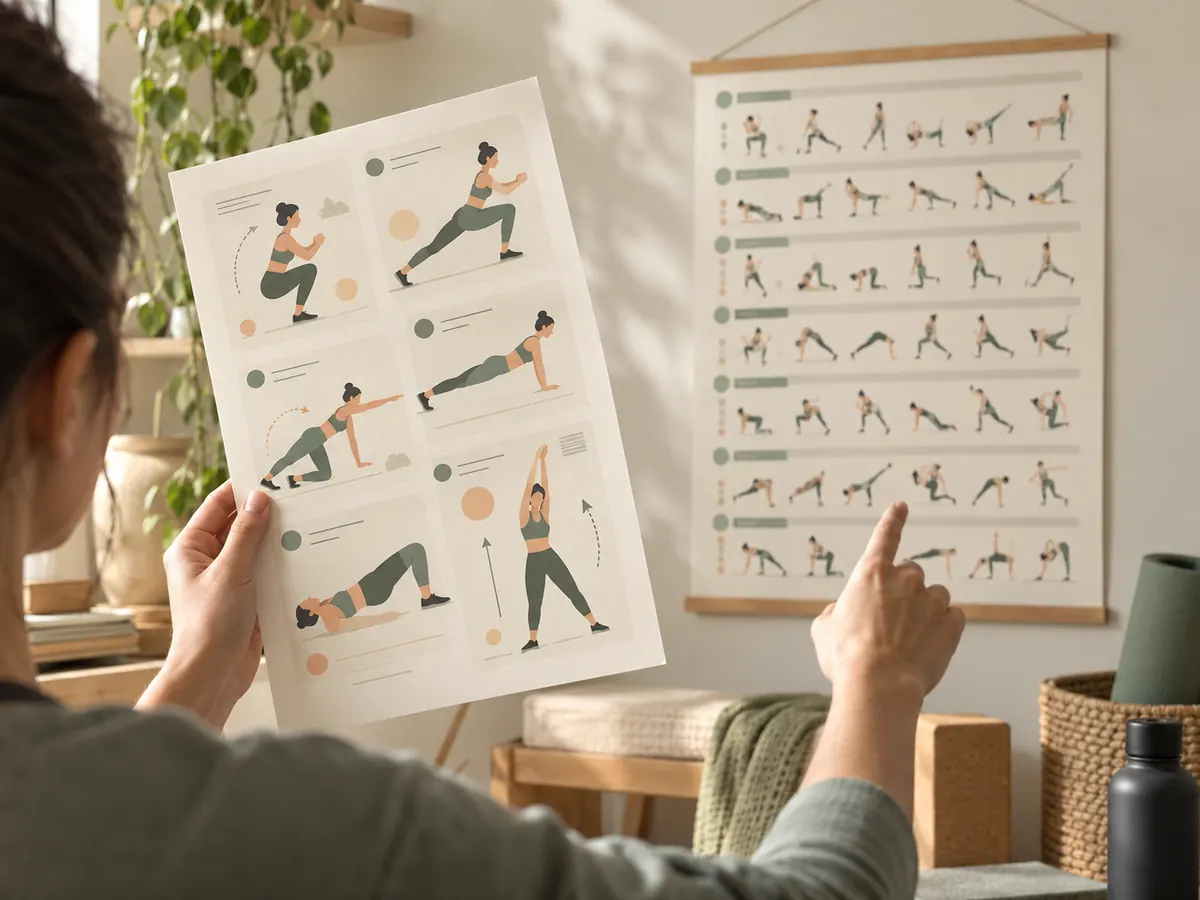
Look for concrete assumptions in the sample: equipment, starting position, floor access, use of support and the amount of explanation. These details help you identify questions without trying the movements as a suitability test. If the page shows a mat, a chair and standing positions, note that mixed setup. Do not decide from the word seated that every part of the collection stays seated. A title can summarize a theme without describing every included page.
Keep uncertain observations as questions. Does the guide explain transitions? Are the chart's movements demonstrated elsewhere? Is the pictured equipment required or decorative? These are factual questions about the resource. When a question concerns your ability to perform something, it belongs with someone who can assess that ability. A PDF cannot observe your balance, symptoms or technique. Reading the assumptions carefully is useful because it prevents a broad audience label from hiding the specific demands visible in the illustrations.
Avoid turning demographic matches into guarantees
Being in the age or audience group named in a listing is not a guarantee that the resource matches your circumstances. A women-focused collection can contain varied equipment and instruction styles. A senior-themed collection can include standing, seated or mixed references. The practical issue is the content, not whether the title appears to describe you. Avoid using demographic similarity as the final reason for purchase, especially when the sample leaves important features unclear.
The same caution applies when buying a gift. A relative's age does not tell you their preferred document format, available equipment or need for support. Ask about the resource's intended role: a visual reference for an existing routine may be different from a guide for unfamiliar activity. A thoughtful gift can be a planning page rather than a movement chart. Give the recipient room to decide how the document fits their circumstances instead of attaching an expectation that they should follow everything it contains.
Ask professionals a document-specific question
If individual advice is needed, make the conversation concrete by showing the actual sample and describing what you want to use it for. Asking whether this kind of reference could support an already discussed routine is more informative than asking whether all beginner PDFs are safe. The professional can see what the page does and does not explain. Keep the distinction between using a document for reminders and relying on it to learn unfamiliar technique.
You do not need to turn the seller conversation into a medical discussion first. Ask the seller for a readable sample, equipment details or the presence of a fuller guide. Then take the relevant information to the person advising you. This sequence gives each party a question they can appropriately answer. A seller's confirmation that the file includes seated illustrations is evidence about content. It is not an individual recommendation about which movements to perform or how to adapt them to your situation.
Recognize when clarity is still missing
A resource can be accurately labelled yet insufficiently explained for your intended use. If the sample only names movements and you need detailed instructions, the gap is instructional depth rather than audience identity. If the writing is tiny, the gap is readability. If your equipment differs from the illustration, the gap is setup. Naming the gap prevents you from trying to solve every problem by finding a different age or gender label.
Use a short note with three headings: confirmed document features, unresolved product questions and individual questions. Under confirmed features, list format and visible content. Under product questions, list missing explanations. Under individual questions, record anything that requires personal assessment. This is not a clinical screening tool. It is a way to keep a shopping decision from swallowing questions the product cannot answer. A clear separation also helps you explain why a seemingly well-matched title may still not be the right resource for your task.
Choose a role before choosing a routine
A fitness printable can serve as a reference, a planning aid, a recording sheet or an educational reading resource. Decide which role you want first. You may find that a blank log meets your current need while a movement collection requires more individual discussion. Owning a chart does not oblige you to use it immediately, and buying a larger collection does not create a reason to try every page. The document should support your decisions rather than dictate them.
After purchase, check that the delivered file matches the role you selected. Keep any questions beside the relevant page instead of inferring missing guidance from the title. If the resource is used as a reminder within an established routine, preserve that context in your notes. Do not let a catalogue label become a substitute for the specific guidance you already have. The most useful purchase is one whose contents and limits you understand, even when its audience label feels like a natural match.
Use audience labels to locate resources, then inspect their actual features. Keep readability, product contents and individual movement suitability as separate questions with appropriate sources of clarification.
Written for general information by The Better Plans. Exercise and wellness content cannot diagnose a condition or replace individual professional advice. The Better Plans also sells digital products on Etsy, but this article is free to read and requires no purchase. Read our editorial policy or send a correction.